
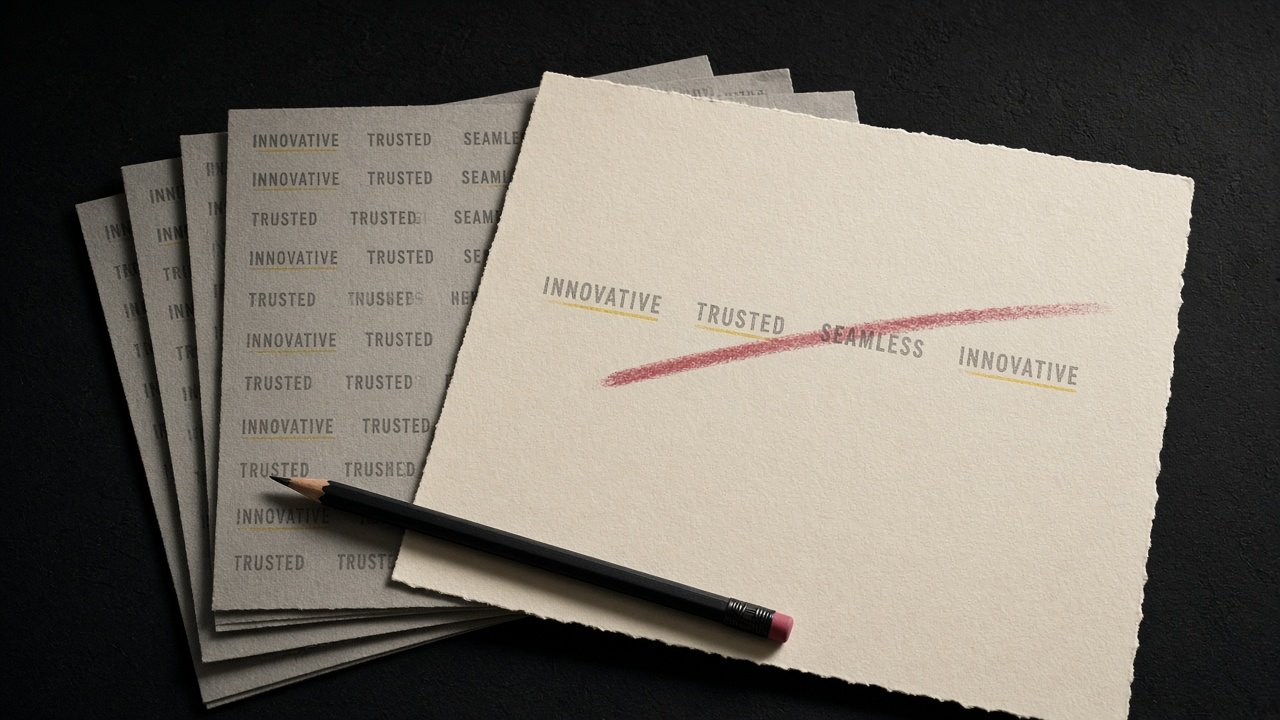
Open five competitor websites in a row. Do it after lunch, when you are slightly impatient and still honest.
You will meet the same room of words. Innovative. Trusted. Seamless. Customer-first. World-class. Purpose-led. Future-ready. Each brand says them as if they were news. Lined up, they cancel each other out. The more carefully they were approved, the more identical they become.
That is not a writing problem. It is a positioning problem wearing a copy hat.
The template is comfortable
Categories train everyone. A finance brand learns to sound solid. A tech brand learns to sound next. A consumer brand learns to sound warm and slightly better than last year. The template works. It gets through legal. It survives the steering committee. Nobody gets fired for sounding like the market.
Which is exactly why nobody remembers you a week later.
When every rival claims the same handful of virtues, the audience stops listening for meaning and starts listening for difference. If you have not given them one, they invent one for you — usually price, or habit, or whoever showed up first in the feed.
Find the space the room trained itself to ignore
Good brand strategy does not begin with a moodboard. It begins with a map of what the category already shouts. Read the rivals in their own words until the pattern is boring. Boring is useful. Boring shows you the fence.
Then look for the gap the fence was built to hide. Sometimes it is a truth everyone knows and nobody will say. Sometimes it is a trade-off the category pretends does not exist. Sometimes it is a customer irritation that has been normalised into silence.
That gap is the job. Not a longer list of adjectives. One territory you can own because you are willing to give something else up.
Positioning is a decision, not a paragraph
A position that costs you nothing is not a position. If you can still claim every virtue on the wall, you have not chosen. You have decorated.
The useful test is simple: can another company in your category say the same sentence without lying? If yes, keep going. If no — if saying it would feel slightly wrong in their mouth — you may have found something worth building language around.
From there the work gets practical. What gets a name. What gets a line. What disappears. What every team can use on Monday without a translator in the room. Strategy that only lives in a deck is theatre. Strategy that shows up in a subject line is work.
Why we start here
At 13th Pencil, Brand & Strategy is the first practice for a reason. Creative that arrives before a position has somewhere to land will look finished and feel interchangeable. Growth that scales an unclear message will only make the sameness louder. AI that generates variations of a default will fill the calendar without moving the brand an inch.
We look for the tension in the category before anyone designs anything. Not because design does not matter — because design deserves something worth defending.
If your market already agrees on the adjectives, bring us that agreement. The interesting work starts where it ends.